Call Us: +604-399 9907
Email Us: salesbw@fonkok.com.my

24, Lorong Talang 9, Taman Mas, 13600 Prai, Penang.
Call Us: +604-399 9907
Email Us: salesbw@fonkok.com.my
24, Lorong Talang 9, Taman Mas, 13600 Prai, Penang.

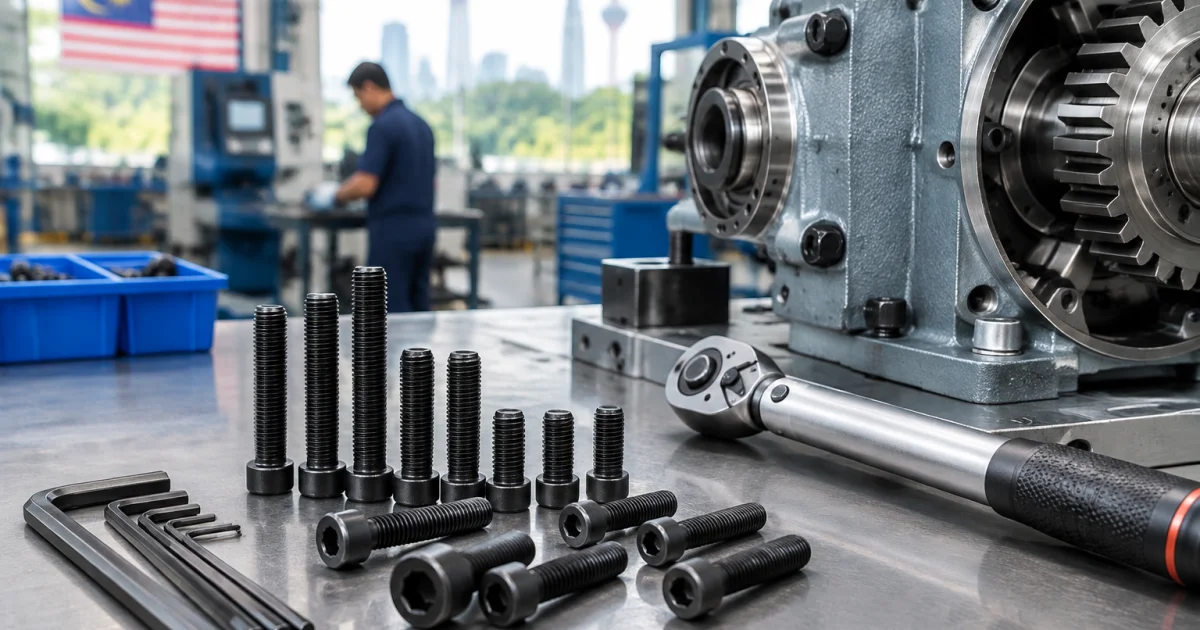
In Malaysian plants and machine shops, socket head cap screws often get treated as “just another item on the BOM.” My view: that mindset is exactly why teams get hit with avoidable failures—rounded hex sockets during shutdown work, repeat loosening on vibrating equipment, or inconsistent preload that shows up later as alignment issues.
But I’m equally opinionated on the other side: specifying Unbrako for every socket screw is an expensive habit that can tie up budget and lead time without improving reliability. The best procurement and maintenance teams treat premium socket screws as a tool: used deliberately on the joints that actually need it.
If you’re evaluating an Unbrako Fastener Supplier Malaysia option for urgent maintenance or planned builds, the question isn’t “Is Unbrako good?” It’s “Where does it change risk, downtime, and total cost in our machines—and where does it not?”
Socket screws live and die by consistency. In critical joints, a few small differences can separate a clean torque-up from a stripped internal hex, and a stable clamp load from a joint that relaxes over time.
In practice, specifying Unbrako-grade socket screws is usually about reducing variability across:
None of that is “magic.” It’s simply that higher-end socket screws tend to be specified and controlled more tightly—useful when a failure mode is expensive.
Also important: “premium socket screw” is not the same as “correct socket screw.” A wrong length, wrong thread engagement, wrong material for corrosion, or wrong tightening practice will still fail—regardless of brand.
My line is simple: specify Unbrako when the consequence of a bad joint is higher than the incremental cost of premium screws—and when your team can actually realize the benefit through proper tightening and installation.
Examples include couplings, gearbox housings, servo mounts, bearing caps, linear guide mounting, and machine frames where alignment is sensitive. Here, a rounded socket or a screw that can’t hold preload can turn a 30-minute task into a multi-hour tear-down. In Malaysia, that often means lost production shift time and emergency purchasing.
Socket head cap screws are often chosen specifically because you need high strength in a compact head. Where you’re pushing load capacity in a tight envelope, the upside of consistent high-grade socket screws is more tangible.
If the joint is opened often—guarding, tooling change points, service panels on machinery—socket durability matters. A better-controlled hex socket and head geometry reduces rounding and reduces the chance that a mechanic “cheats” with the wrong tool because the correct key no longer seats properly.
Dynamic loads don’t just loosen fasteners; they amplify the cost of inconsistency. If your baseline process already includes appropriate locking methods (threadlocker, lock washers where appropriate, prevailing torque nuts in related joints), using a consistent high-grade socket screw can help you hold design intent in real-world conditions.
Some procurement teams choose to standardize critical socket screw lines (selected sizes/lengths) to ensure every shutdown kit has the same reliable performance. This is a reasonable strategy if it’s limited to “A-joints” rather than across the entire plant.
Over-specification is real, especially when “premium” becomes a default. In my experience, these are the typical situations where spending up doesn’t buy you measurable reliability.
The practical takeaway: if you can’t articulate the failure mode you’re paying to avoid, you’re probably over-specifying.
If you’re deciding whether to call out Unbrako socket screws for a machine build or a maintenance program, I’d run through these questions with engineering and maintenance together. The goal is to match the spec to the risk, not to the habit.
| Decision factor | Specify Unbrako is usually justified when… | Standard socket screws may be enough when… |
|---|---|---|
| Downtime impact | A stripped socket or loosened joint will extend shutdown or stop a line | Failure is non-critical and repair is quick |
| Load criticality | Joint is near design limits, high clamp load is required, or alignment is sensitive | Loads are low and base material governs |
| Access & serviceability | Access is awkward; tool engagement must be reliable over repeated cycles | Easy access, low cycle count, low risk of socket damage |
| Environment | Controlled indoor environment where strength/consistency is the key risk | Corrosion is the dominant risk and material/coating choice matters more |
| Process maturity | Torque specs, calibrated tools, and installation discipline exist (or can be implemented) | No consistent tightening practice; improvement should start with process |
| Supply plan | Critical sizes are planned/stocked; substitutes are controlled | Ad-hoc buying is common; start with standardization and kitting |
Notice what’s missing: I’m not saying “premium always wins.” I’m saying “premium wins when the joint is expensive to get wrong and the organization can maintain the discipline to capture the upside.”
Because this is BOFU decision-making, here’s the part that actually protects you: verification. Brand callouts help, but procurement still needs clarity on what arrives on the dock—especially when you’re trying to prevent line stoppages or repeat failures.
“Socket screw” can mean several head styles and use cases. Align the request to the exact item you need—socket head cap screw, button head, countersunk, or set screw. If you’re unsure, start from the assembly drawing and confirm the head style clearance, seating surface, and drive access.
If your requirement is broad (“we need socket screws”), it’s easy to receive the wrong type and force a workaround on the floor. For reference browsing and internal standardization, you can group what you commonly use under a dedicated socket screw category.
In coastal, humid, washdown, or chemical-adjacent environments, “stronger” may not be “longer-lasting.” For many Malaysian sites, corrosion management is a bigger reliability lever than strength grade alone. If the joint faces corrosion risk, decide the material/finish strategy first (and then decide which brands/sources meet it).
If you’re fighting loosening, look beyond the screw. Washers, locking components, and set screws can make or break the assembly outcome. For example, in shaft collars, hubs, pulleys, or fixtures where a set screw is doing real work, selecting the correct point style matters. If you regularly use cone-point set screws for positive location, align your sourcing to a known spec such as Hex Socket Set Screw With Cone Point Din 914. For general holding power on shafts, a hex socket set screw with cup point is often the more common baseline.
My opinion: the “right” supplier isn’t only the one who can quote. It’s the one who can help you reduce firefighting. For maintenance teams, that looks like: confirming equivalents early, supporting partial delivery for shutdown windows, and helping you consolidate sizes so you stock fewer SKUs without compromising your critical joints.
Specifying Unbrako socket screws in Malaysia makes the most sense when you’re protecting uptime: high-consequence joints, high clamp loads in compact spaces, repeated service cycles, and dynamic loading where inconsistency becomes expensive. It makes less sense when the joint is non-critical, the base material is the weak link, corrosion dominates the failure mode, or your installation process is uncontrolled.
If you take only one action after reading this: pick the top 10 socket-screw joints that have caused you the most downtime in the last year, and decide whether the root cause was (a) screw quality/consistency, (b) joint design, (c) corrosion/material choice, or (d) installation practice. Then you’ll know exactly where a premium spec is justified—and where standardization and process will get you a better ROI.
Not always. Unbrako is most justified when failure is costly—critical joints, high clamp loads, poor access, or repeated service cycles. For guards, light brackets, and low-load covers, standard socket screws can be perfectly adequate. Decide based on consequence, not habit.
Provide the exact type (socket head cap, button head, countersunk, set screw), size (diameter and length), thread (coarse/fine where applicable), material/finish needs, and any standard callouts from the drawing. Also state if it’s a blind-hole application to prevent bottoming-out issues.
Corrosion problems are usually solved by the right material and finish strategy, not by strength grade alone. In humid, coastal, or washdown environments, focus first on corrosion-resistant options and installation practice. Then choose a reliable source that can supply that specification consistently.
Use cone point (e.g., DIN 914) when you need positive location into a dimple or to resist movement on a defined point. Use cup point for general holding power on shafts and collars where you want strong bite without a sharp point. Match the point style to the shaft condition and service needs.
Ask about availability for your critical sizes, support for partial/priority deliveries, and how equivalents are confirmed when a size is short. A good supplier helps you reduce emergency substitutions by planning stock lines around your high-risk joints and verifying specs before dispatch.
Fon Kok Fastener Sdn Bhd supports Malaysian engineering, manufacturing, and maintenance teams with a one-stop range of socket screws, bolts, nuts, washers, anchors, rivets, pins, and specialised fasteners. If you’re deciding where Unbrako-grade socket screws are truly worth specifying—or you need the right set screw, cap screw, or locking components for an urgent shutdown—our team can help you match the specification to the application and supply plan.


